Time-derivative rendering
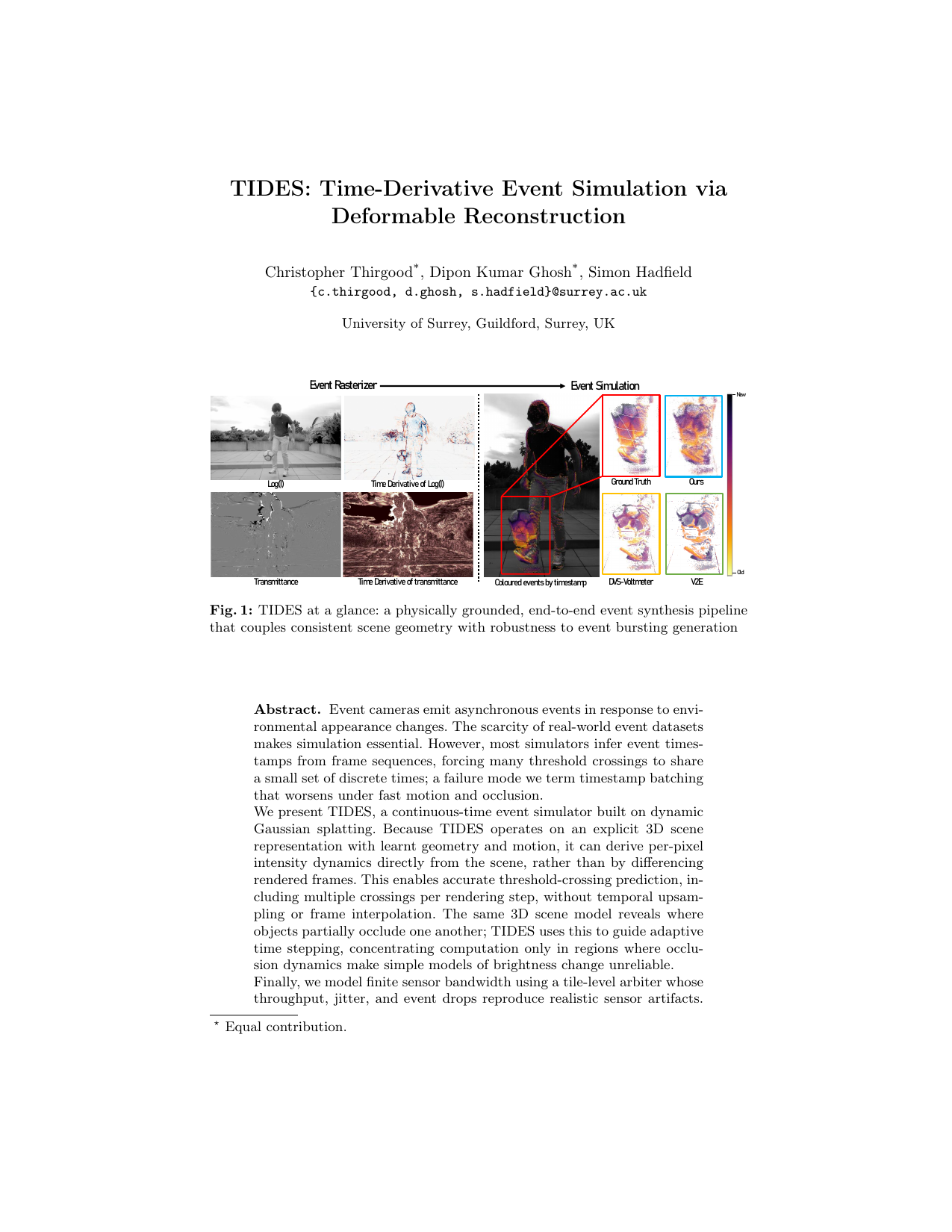
Forward-mode rasterization produces log-luminance and its instantaneous derivative in the same visibility ordering.
University of Surrey, Guildford, Surrey, UK
ECCV 2026
* Equal contribution
Event stream comparison showing ground truth, TIDES, and baseline simulators.
Event cameras emit asynchronous events in response to changes in scene appearance. TIDES simulates these events directly from a dynamic Gaussian splatting scene, deriving per-pixel intensity dynamics from the scene rather than differencing rendered frames.
This continuous-time formulation predicts threshold crossings, including multiple crossings per rendering step, without temporal upsampling or frame interpolation. It is designed to avoid timestamp batching, where many events are forced to share the same discrete rendering times under fast motion or occlusion.
The simulator also uses scene visibility cues to adapt its time stepping and models finite sensor bandwidth with a tile-level readout arbiter, reproducing burst-induced timestamp spreading and event drops.
Forward-mode rasterization produces log-luminance and its instantaneous derivative in the same visibility ordering.
Adaptive sampling concentrates computation near mixed visibility, disocclusions, and fast-changing opacity.
A finite-bandwidth arbiter captures localized event bursts, jitter, and drops under high activity.
The videos compare synchronized ground-truth events, simulated events, and RGB motion cues across paired event-RGB datasets. Motion reveals timing drift, burst fragmentation, polarity flicker, and short-lived edge events that can be hidden in static event frames.
Event stream fidelity under ego-motion and low-light appearance changes.
Street-scene ego-motion with structured event bursts and visibility changes.
Fast dynamic motion where temporal dispersion along boundaries matters.
Dynamic object motion with synchronized event and RGB reference cues.
TIDES also probes viewpoint extrapolation by training from a monocular capture while the camera moves around a playing video display, then simulating events from novel views.
Polarity-colored events rendered from the extrapolated trajectory.
RGB reference frames for the novel camera path.
Scene reconstruction cues used by the deformable representation.
Christopher Thirgood, Dipon Kumar Ghosh, and Simon Hadfield. TIDES: Time-Derivative Event Simulation via Deformable Reconstruction. ECCV 2026.
@inproceedings{thirgood2026tides,
  title = {TIDES: Time-Derivative Event Simulation via Deformable Reconstruction},
  author = {Thirgood, Christopher and Ghosh, Dipon Kumar and Hadfield, Simon},
  booktitle = {European Conference on Computer Vision (ECCV 2026)},
  year = {2026},
  url = {https://github.com/ThirgoodC/TIDES}
}